What Is the Mark Price, and Why Does Liquidation Follow It Instead of the Last Price?
You open a futures position, a wick stabs clean through your liquidation price, and the position is still there. The Binance futures screen actually carries two numbers, the last price and the mark price: the wick hit the last price, but liquidation and unrealized PnL are measured against the mark price.
This is risk and fee education, not investment advice.
1. Why one contract has two prices
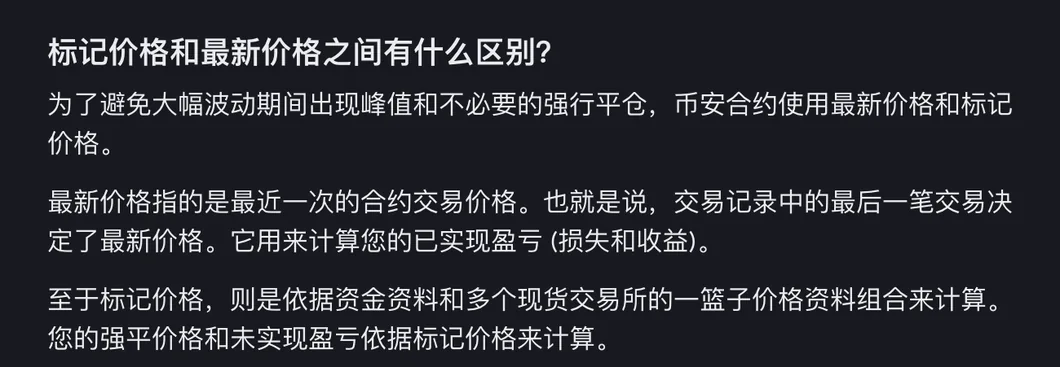
According to Binance's futures liquidation protocols, contracts use both a last price and a mark price to avoid price spikes and unnecessary liquidations during periods of heavy volatility:
- Last price: the price of the most recent futures trade, set by the final fill in the trade history. It is used to calculate realized PnL.
- Mark price: calculated from funding rate data combined with a basket of prices from multiple spot exchanges. Both the liquidation price and unrealized PnL are based on it.
Before you read a candlestick chart, check which of the two prices it is plotting; the one that decides whether you get liquidated is the mark price. In heavy volatility the two can pull apart, and there is no fixed size for that gap. The liquidation protocols describe how to switch views: in the app, open Futures, make sure you are using the Classic trading mode, tap the chart icon, then tap the last price toggle to switch; on the web, click the last price toggle on the trading chart.
2. Which price liquidation actually watches
The liquidation protocols put it plainly: a position is liquidated when the mark price reaches that position's liquidation price. Underneath sits a simple test of whether your margin is still enough:
Collateral = initial collateral + realized PnL + unrealized PnL < maintenance margin → liquidation
Unrealized PnL is calculated at the mark price, so every move in the mark price shifts the collateral on the left-hand side; Binance's mark price page also names unrealized PnL as the main factor in triggering liquidation. Binance defines the margin ratio as maintenance margin / margin balance, and liquidation happens at 100%. Its advice is to keep the margin ratio below 80% and to add margin or reduce the position when you get close to that line.
- A last price wick touching your liquidation price is not a liquidation. The trigger in the protocols is the mark price reaching the liquidation price, so what matters is where the mark price was at that same moment; the liquidation price itself also moves as your collateral changes. Filtering out this kind of unnecessary liquidation is exactly what the mark price is for.
- If the mark price gets there before the last price does, you are still liquidated. Anyone watching only the last price will feel they were closed out for no reason. To judge how far you are from liquidation, compare your liquidation price with the mark price.
For how to estimate the liquidation price itself and how leverage shifts it, see how the liquidation price is calculated and how much leverage to use.
3. How the mark price is calculated
According to Binance's help center explainer on the mark price and price index for USDⓈ-M futures, the mark price is determined by the price index, the funding rate, the best bid and best ask in the futures order book, and the last futures price (the Chinese-language version of that page was marked as updated on 2026-07-09).
The price index: a weighted average of spot prices
The price index takes the underlying asset's spot price on multiple trading venues and averages them by weight. The sources include centralized venues such as Binance, KuCoin, OKX, Coinbase, Kraken, Bitget and Bybit, as well as decentralized exchanges such as PancakeSwap (BNB Chain), Uniswap (Ethereum) and Raydium (Solana). The Binance futures last price may also be one of the components, and Binance can change the components at any time. In practice, you can read the price index as the spot price.
To keep any single source from dragging the index off course, several safeguards apply:
- If a venue's price deviates from the median of all sources by more than 3%, it is capped at 1.03× or 0.97× the median when it is included (for some pairs such as BTCUSDT and ETHUSDT the cap is 1%). For example, with a median of 20,000 and one venue 7% above it, that venue counts as 20,600.
- If a venue has not updated its trade data within five minutes, its weight in the average drops to zero.
- When no stable reference is available, last price protection kicks in and the price index temporarily updates from the last traded futures price within the capped range.
The mark price: the middle of three prices
Mark price = Median(Price 1, Price 2, Contract price)
Price 1 = Price index × (1 + Latest funding rate × Time until next funding / Funding interval)
Price 2 = Price index + Moving average of the 30-second basis
The moving average in Price 2 works like this: once per second for 30 seconds, take (best bid + best ask) / 2 − price index, then average those 30 data points. The three prices are sorted and the middle one is used; for example, if Price 1 < Price 2 < Contract price, the mark price is Price 2. As for the time until next funding in Price 1: if the funding interval is set to 8 hours and the last funding was collected 2 hours ago, the next one is 6 hours away. The interval is not always 8 hours. For what the funding rate is and who pays whom, see what the perpetual funding rate is.
The net effect is that the mark price moves less in the short term than the perpetual contract price. Reading the formula: when the traded contract price briefly spikes, Price 1 depends only on the price index and the funding rate, Price 2 is a 30-second average, and a median of three rarely lands on the extreme tip of a wick. If the deviation persists, though, the 30-second average catches up.
4. Jumps, drift from spot, orders cancelled after liquidation: what the mark price does not cover
Treating the mark price as wick insurance is dangerous. The two help center pages above spell out its limits too:
It can jump quickly as well
The example in the liquidation protocols: a BTCUSDT short is opened at a mark price of 17,000 USDT, and the system calculates a liquidation price of 17,006 USDT. During extreme volatility the mark price jumps from 17,000 to 17,100 within one second. The position is liquidated at 17,100, and the liquidation record shows 17,100 as well, not the 17,006 originally calculated. The mark price does not move in a straight line, and nothing guarantees it will stop neatly at your liquidation price.
It can drift from spot in extreme markets
In extreme market conditions, or when price sources deviate, the mark price may drift away from the spot price, and Binance may take additional measures (such as using Price 2 directly as the mark price). If the mark price moves abnormally sharply in either direction over a short period, Binance reserves the right to put that pair into reduce-only mode (checked against Binance's USDⓈ-M mark price page in September 2026).
What happens once a liquidation fires
- Open orders are cancelled immediately: all open orders in cross margin mode, or all open orders in the same token in isolated margin mode.
- The liquidated position is charged a liquidation clearance fee (bankrupt positions excepted), calculated from the rate in the trading rules and the position's notional value.
- Small positions are more likely to be liquidated in full than large ones, because maintenance margin is set by position size, not by leverage.
- Binance makes reasonable efforts to send margin call and liquidation alerts, but does not guarantee they arrive in time.
5. How to use both prices while you watch the market
- Measure your distance to liquidation with the mark price. Switch the chart to the mark price, then compare it with your liquidation price.
- Read unrealized PnL as a mark price estimate. Closing the position settles at the fill price, so a mismatch between the two is normal.
- Do not let the margin ratio hug 100%. Binance's own line is below 80%. In the liquidation protocols example, the BTCUSDT mark price jumped 100 USDT in a single second during extreme volatility, so you may have less time to react than you think.
- Do not rely on alerts. They are not guaranteed to arrive; if a position is close to the line, watch it yourself.
If after all this you still cannot say how far your position is from liquidation right now, the question of which price to watch can wait. Reduce the position or add margin first to pull the margin ratio away from 100%, and set lower leverage the next time you open a trade.
Frequently asked questions
The last price wicked through my liquidation price. Why wasn't I liquidated?
According to Binance's futures liquidation protocols, liquidation happens when the mark price reaches the position's liquidation price; the last price is used for realized PnL, while the liquidation price and unrealized PnL are calculated from the mark price. So the last traded price touching your liquidation price does not by itself trigger a liquidation. What counts is where the mark price was at that same moment. It works the other way too: if the last price still looks far from your liquidation price but the mark price gets there first, the liquidation is triggered anyway.
Why doesn't my unrealized PnL match what I actually get after closing?
The two use different prices. Binance explains that unrealized PnL is calculated at the mark price, while realized PnL depends on the price you are actually filled at. The floating PnL you see while holding is a mark-price estimate and closing settles at the fill price, so a gap between them is simply how the rules work.
Does the mark price guarantee a wick won't liquidate me?
No. Binance says it uses the mark price to avoid unnecessary liquidations and to prevent market manipulation; it does not promise you won't be liquidated. Its liquidation protocols even give an example: during extreme volatility the mark price jumped from 17,000 to 17,100 within one second, and the position was liquidated at 17,100 rather than at the 17,006 originally calculated.
Where do I switch the chart to the mark price?
The path given in Binance's liquidation protocols: in the app, open Futures, make sure you are using the Classic trading mode, tap the chart icon, then tap the last price toggle to switch; on the web, click the last price toggle on the trading chart directly. Buttons can move after an interface update, so look for the option on the chart that switches between last price and mark price.
This is not investment advice, a trading signal or an account-opening recommendation. Futures trading amplifies losses and you can lose all of your capital in a short time; the formulas and parameters in this article are taken from public explanations in the Binance Help Center, may change at any time, and other exchanges may use different methods.