Futures Exchange Signup Compared: How Six Platforms Take You From Account to First Trade
Most people who stall on their first futures trade did not get the direction wrong. They never got the account working in the first place. You register, then discover you cannot deposit until you have submitted documents. You submit the documents, then discover futures access is a separate switch. You flip that switch, then discover the deposit methods on offer do not include anything available where you live. "Just open an account somewhere" sounds like one instruction, but the actual path from signup to a first contract order looks different on each of the six major platforms. Below, Binance, Bybit, OKX, Gate, Bitget and HTX are compared step by step, from signup to a first order: what you sign up with, what kind of documents verification asks for, how futures access gets enabled, which deposit rails exist, and where beginners most often get stuck. Fees are not compared here.
This is process education, not investment advice, a trading signal or an account-opening recommendation. Document lists, review arrangements, deposit rails and regional availability all change at any time; whatever each exchange's own official page says at the time you read it takes precedence over anything here.
① Start here: the no-verification major exchange is basically gone
Plenty of people still search for a futures platform that skips identity checks, hoping for a shortcut. That idea is out of date. Major exchanges now generally require identity verification before you can deposit, withdraw or open futures (check each exchange's verification page for its own rules).
All six of these platforms require KYC, and the difference is in document types, the order things get enabled and how the experience feels — not in who lets you skip it. You are better off spending that effort working out where each platform's verification tends to hold people up. This comparison covers only the six major platforms — Binance, Bybit, OKX, Gate, Bitget and HTX — and deliberately leaves out small no-verification venues, which typically carry higher counterparty and compliance risk and are outside the scope of this piece.
② What the road from signup to first trade is actually made of
Strip away the interface differences and the route from registration to a first contract order has the same shape everywhere. Only the specifics of each stage change:
- Signup credential — what you open the account with: an email address, a phone number, or either.
- KYC documents — what verification asks for: basic identity details, photos of an ID document, face verification, and whether there are basic and advanced tiers.
- Enabling futures access — spot and futures are usually separate permissions, and enabling futures may require reading a risk disclosure or completing a short risk questionnaire first.
- Deposit rails — whether you can buy with local fiat directly, whether there is a C2C (peer-to-peer) marketplace, or whether an on-chain transfer of crypto you already hold is the only realistic route.
- The first order — once funds land, whether you need to move them between the spot and futures balances first, and how directly the interface leads to placing an order.
Get blocked at any one of these five and the whole route stops. Which is why the useful question when picking a platform is not only "whose fees are lowest" but "which stage is most likely to block me."
③ Six platforms side by side: where the process differs
The table shows only the type of approach each platform takes at each stage. Fees, limits, leverage caps and review times change often; check the official page on the day you open the account.
| Exchange | Signup credential | KYC document type | Enabling futures | Deposit rail types | Where beginners get stuck |
|---|---|---|---|---|---|
| Binance | Email / phone | Basic identity details + ID document, tiered | Enabled separately after completing the futures risk quiz (the enable page has the current steps) | Fiat card, C2C and on-chain transfers all supported | Broad product line; easy to wander past the derivatives section |
| Bybit | Email / phone | ID document + face verification, tiered | Enabled after confirming a risk questionnaire | C2C, some fiat channels, on-chain transfers | Easy to miss the transfer between the unified account and futures funds |
| OKX | Email / phone | ID document + face verification, tiered | Enabled after reading a risk disclosure | C2C, on-chain transfers, some fiat channels | Easy to confuse the Web3 wallet entry with the trading account |
| Gate | Email / phone | ID documents, tiered | Enabled after a risk confirmation | Mainly C2C and on-chain transfers | Many contract types listed; easy to open the wrong one |
| Bitget | Email / phone | ID document + face verification, tiered | Enabled after confirming a risk questionnaire | C2C, some fiat channels, on-chain transfers | Easy to mix up the futures entry with the copy-trading area |
| HTX | Email / phone | ID documents, tiered | Enabled after reading a risk disclosure | Mainly C2C and on-chain transfers | Worth checking you have the right interface language and account type |
The above is a structural summary. Document lists, verification tiers, the range of deposit rails and regional availability are adjusted often, so treat each exchange's own current page as authoritative; where anything here differs from the latest official wording, the official wording wins.
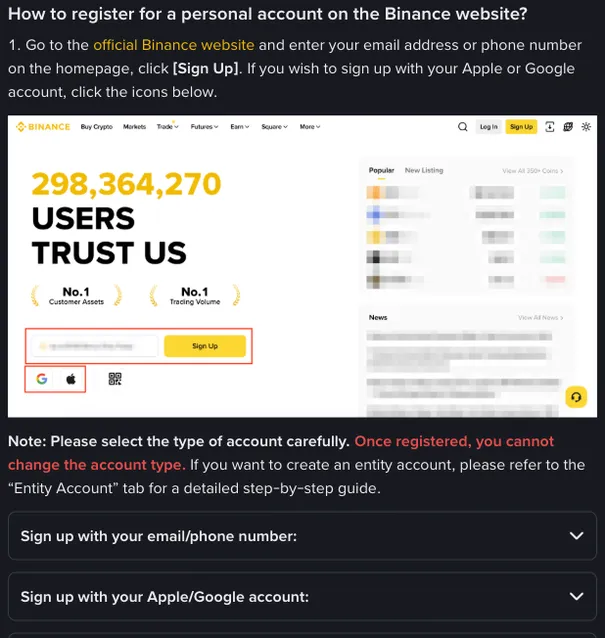
④ Who each of the six suits
These are notes on how the products are structured, not a ranking and not a verdict on who is better — the same platform can be the right and the wrong answer for two different people:
- Binance — the broadest product line and comparatively more fiat deposit options, which suits people who would rather not move between platforms later and want to use one venue for everything.
- Bybit — a direct interface with a clear path through derivatives, which suits a first-time futures user who wants fewer detours. The signup and first-position steps are walked through here.
- OKX — keeps the Web3 wallet and the trading account inside one ecosystem, which suits people who want to try both at once.
- Gate — comparatively wide contract coverage, which suits people watching newly listed instruments and wanting a broader trading range.
- Bitget — carries copy-trading and strategy-marketplace style features, which suits people happy to look at how others have positioned themselves.
- HTX — a longer-established localised service and community, which suits users already familiar with that ecosystem.
⑤ Where beginners actually get stuck (all six share this)
Looking across the six, the sticking points are remarkably concentrated and barely platform-specific:
KYC documents get rejected
The usual causes are mundane: a blurry photo of the document, corners cropped out of frame, or a document type that does not match the tier the platform asked for. Checking lighting, sharpness and whether the whole document is in shot before you submit saves you a full review round-trip.
Clicking straight through the futures risk questionnaire
A lot of people treat the risk disclosure or questionnaire in front of futures access as a Next button and click it away. That document describes exactly what you are about to face for real — how leverage magnifies risk and what conditions get a position force-closed. If you would rather understand the mechanics first, read how the liquidation price is calculated and how to choose a leverage multiple, then enable access. Reading those first beats getting to the end of the agreement none the wiser.
Picking the wrong deposit rail or network
The other frequent blocker is the deposit itself: an on-chain transfer sent over the wrong network, or a fiat channel that turns out not to be supported where you live. For on-chain transfers, always confirm the sender and receiver are using the same chain. Which fiat methods are available varies by region, so opening the official deposit page and reading what is currently offered to you is more reliable than going on memory.
Past those three, once the first order goes through, the thing that quietly keeps affecting your account is the cost of holding — funding and trading fees eat into your capital while you are not paying attention. The mechanics are covered in what the funding rate is. Understanding those up front is worth considerably more than second-guessing afterwards which platform you should have picked.
⑥ For a first futures account, a smooth process matters more than the lowest fee
Having read all six process comparisons, you may still not have a single answer — which is fine, because there is no platform that is optimal for everyone. The first time you trade futures, picking the route with the fewest places you personally get stuck, and completing signup → KYC → futures access → deposit → first order end to end, matters more than a marginally cheaper fee schedule. How smooth the process is decides whether you give up halfway, or place a rushed order on a set of rules you never understood.
If you have not settled on what criteria to judge platforms by, start with how to choose a futures exchange, which is about weighing fees, risk and regional availability against each other. If you would rather follow the steps in order, how to register on Bybit and trade futures breaks down every step from signup to a first position.
Signup, KYC and deposits are all handled by the exchange itself. Before committing time to any of the six, check the current document list, futures-access steps and deposit options for your region on that platform's own official pages; this site receives a promotion service fee on partner links and promises no fee, reward or registration eligibility.
Frequently asked questions
Are there still major futures exchanges that let you trade without KYC?
Essentially none. Over the past couple of years, under global compliance pressure, major exchanges have moved identity verification from optional in some steps to a mandatory prerequisite for deposits, withdrawals and futures access. That is an industry-wide shift rather than one platform's policy. Instead of hunting for a no-verification shortcut, it is more useful to find out in advance what documents and steps each platform asks for, and spend your time on a route that can actually be completed.
Is futures access the same thing as a spot account?
No. Most platforms treat spot and futures (derivatives) as two separate permissions, so even after you have registered and cleared KYC you still have to enable futures access on its own, usually after reading a risk disclosure or completing a short risk questionnaire. Funds may also sit in separate spot and futures balances, which means that after depositing you often have to transfer once by hand. That is the step beginners miss most often.
For deposits, should I use an on-chain transfer or a fiat channel?
It depends on what you already hold. If you already own crypto, an on-chain transfer is the more direct route, but you have to confirm that the sender and the receiver are using the same network, because choosing the wrong chain can leave the assets unrecoverable. If you only hold fiat, it comes down to which localised deposit methods the platform supports in your region, and the exact scope, limits and settlement times are whatever the official page states at the time you check.
Which of these six is actually the easiest to deposit into?
There is no single answer to that. How easy depositing feels depends on which rails are supported in your region, which assets you already hold, and how familiar you are with preparing the documents, and all of those can differ from region to region and from one moment to another. This article compares process structure only and does not rank anyone as best. The practical move is to open the official deposit page of the platforms you are considering and see what is actually available to your region right now.
This is not investment advice, a trading signal, a ranking or an account-opening recommendation. Contract trading amplifies losses and you can lose all of your capital in a short time; the signup steps, KYC documents, futures access and deposit rails described in this article are framework-level descriptions only, change at any time, and are subject to each exchange's official live page and your local law. Futures trading is regulated or even restricted in many jurisdictions, so confirm first that it is lawful where you live.
Sign-up links here carry our referral code for Binance, OKX, Bybit and other exchanges (9 in total). Clicking an official-site button takes you off this site, where registration, KYC and trading are handled by the third party. Full risk disclosure → · Affiliate disclosure →